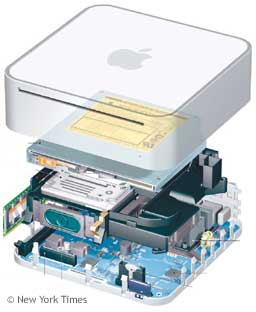
Hackintosh.com links to everything you need to build a Hackintosh and get macOS Catalina (10.15) as well as many earlier versions of Mac OS X running on an unsupported computer - instructions, step-by-step 'how to' guides, and tutorials - in addition to installation videos, lists of compatible computers and parts, and communities for support. For Mac specs, prices, answers, side-by-side Mac. Jun 10, 2020 Reassemble the Mac Mini reversing the steps above, first installing the black shroud, then the fan, then the wireless shroud. Line the markings on the base up with the corresponding markings on the Mac Mini. Twist the base back into place. One additional thing to do throughout this process is to use some canned air to blast out any dust. Apr 08, 2010 You'd also have to route the power connection and ports from the Mac mini to the dome somehow, or again have some unattractive holes in the dome. And the Mac mini may have cooling issues, if airflow was restricted inside the dome. So I don't think it would be worth the effort. Better to preserve the iMac G4 for what it is, a memorable iMac design.
Reinstall from macOS Recovery
macOS Recovery makes it easy to reinstall the Mac operating system, even if you need to erase your startup disk first. All you need is a connection to the Internet. If a wireless network is available, you can choose it from the Wi-Fi menu , which is also available in macOS Recovery.
1. Start up from macOS Recovery
To start up from macOS Recovery, turn on your Mac and immediately press and hold one of the following sets of keys on your keyboard. Release the keys when you see an Apple logo, spinning globe, or other startup screen.
Command (⌘)-R
Reinstall the latest macOS that was installed on your Mac (recommended).
Option-⌘-R
Upgrade to the latest macOS that is compatible with your Mac.
Shift-Option-⌘-R
Reinstall the macOS that came with your Mac, or the closest version still available.
You might be prompted to enter a password, such as a firmware password or the password of a user who is an administrator of this Mac. Enter the requested password to continue.
When you see the utilities window, you have started up from macOS Recovery.
2. Decide whether to erase (format) your disk
You probably don't need to erase, unless you're selling, trading in, or giving away your Mac, or you have an issue that requires you to erase. If you need to erase before installing macOS, select Disk Utility from the Utilities window, then click Continue. Learn more about when and how to erase.
3. Install macOS
Mac G4 Laptop
When you're ready to reinstall macOS, choose Reinstall macOS from the Utilities window. Then click Continue and follow the onscreen instructions. You will be asked to choose a disk on which to install.
- If the installer asks to unlock your disk, enter the password you use to log in to your Mac.
- If the installer doesn't see your disk, or it says that it can't install on your computer or volume, you might need to erase your disk first.
- If the installer is for a different version of macOS than you expected, learn about macOS Recovery exceptions.
- If the installer offers you the choice between installing on Macintosh HD or Macintosh HD - Data, choose Macintosh HD.
Please allow installation to complete without putting your Mac to sleep or closing its lid. During installation, your Mac might restart and show a progress bar several times, and the screen might be empty for minutes at a time.
If your Mac restarts to a setup assistant, but you're selling, trading in, or giving away your Mac, press Command-Q to quit the assistant without completing setup. Then click Shut Down. When the new owner starts up the Mac, they can use their own information to complete setup.
macOS Recovery exceptions
The version of macOS offered by macOS Recovery might vary in some cases:
- If macOS Sierra 10.12.4 or later has never been installed on this Mac, Option-Command-R installs the macOS that came with your Mac, or the closest version still available. And Shift-Option-Command-R isn't available.
- If you erased your entire disk instead of just the startup volume on that disk, macOS Recovery might offer only the macOS that came with your Mac, or the closest version still available. You can upgrade to a later version afterward.
- If your Mac has the Apple T2 Security Chip and you never installed a macOS update, Option-Command-R installs the latest macOS that was installed on your Mac.
- If you just had your Mac logic board replaced during a repair, macOS Recovery might offer only the latest macOS that is compatible with your Mac.
If you can't get macOS Recovery to offer the installer you want, you might be able to use one of the other ways to install macOS.
Other ways to install macOS
- You can also install macOS from the App Store or Software Update preferences. If you can't install macOS Catalina, you might be able to install an earlier macOS, such as macOS Mojave, High Sierra, Sierra, El Capitan, or Yosemite.
- Or create a bootable installer disk, then use that disk to install macOS on your Mac or another Mac.
I have been toying with this idea for a while and its about time that I do something about it... I want to make an intel mac mini powered Lampshade iMac...
I know its been done before but I cant seem to find the data or pinout sheets for the lampshad LCD display to DVI and I was wondering if anyone knows where I can find a guide on doing this? (I saw one a couple years back, but I didnt have a mac mini then...)
Is this a good question?
Hack Into Mac Mini G4 Computer
Comments:
Hey Thanks a lot for the info! I'm sure something there will help me out!
good luck with your project, i hope that i could start mine soon - i halve almost everything here (didn't found the pervect optical drive - to bad that apple does not support bluray - but maybe i would use it anyway and fire up windows for this (my mini itx board has 2 vga and 1 hdmi out)
I want to know how it went too! I want to save my lampshade from the recycle bin - it's such a beautiful bit of industrial engineering.
So, I have to ask (because I just now had this same thought and this was the #1 hit on Google for my search): How did it go? Was the result worth the time and effort?
My experience to date in opening up Macs is primarily to add memory and change the clock battery, but I'm not shy about giving this a try on a 10 year old Mac that I personally think is the coolest machine Apple ever produced. I hate the idea of disposable technology, and this would at least keep a significant portion of the machine 'alive.'
Mac G4 Desktop
Thanks - hope you're still getting updates from this thread. If you'd prefer to reply by email, I'm charliez # aol # com (replace punctuation accordingly).